Passionflower for anxiety shows promise as a natural remedy. Research indicates this herb can effectively reduce anxiety symptoms, with clinical studies finding it works as well as conventional anti-anxiety medications but with fewer side effects.
Used for centuries to calm the nervous system and improve sleep, passionflower offers a gentler alternative to pharmaceutical options. Still, how effective is it compared to other herbal options more suitable for anxiety?
Key Highlights
- Passionflower reduces anxiety effectively – Clinical studies show passionflower works as well as prescription anti-anxiety medications like oxazepam for generalized anxiety disorder, but with fewer side effects like drowsiness or impaired job performance.
- Works best as a complementary treatment – While passionflower can reduce anxiety symptoms and improve sleep quality, it delivers the best results when combined with other treatments like therapy or lifestyle changes, typically taking 2-4 weeks of consistent use to reach full effectiveness.
- Safe but requires precautions – The FDA considers passionflower generally safe at doses of 300-500 mg daily, but it can interact with sedatives, blood pressure medications, and blood thinners.
Table of Contents
What is Passionflower?
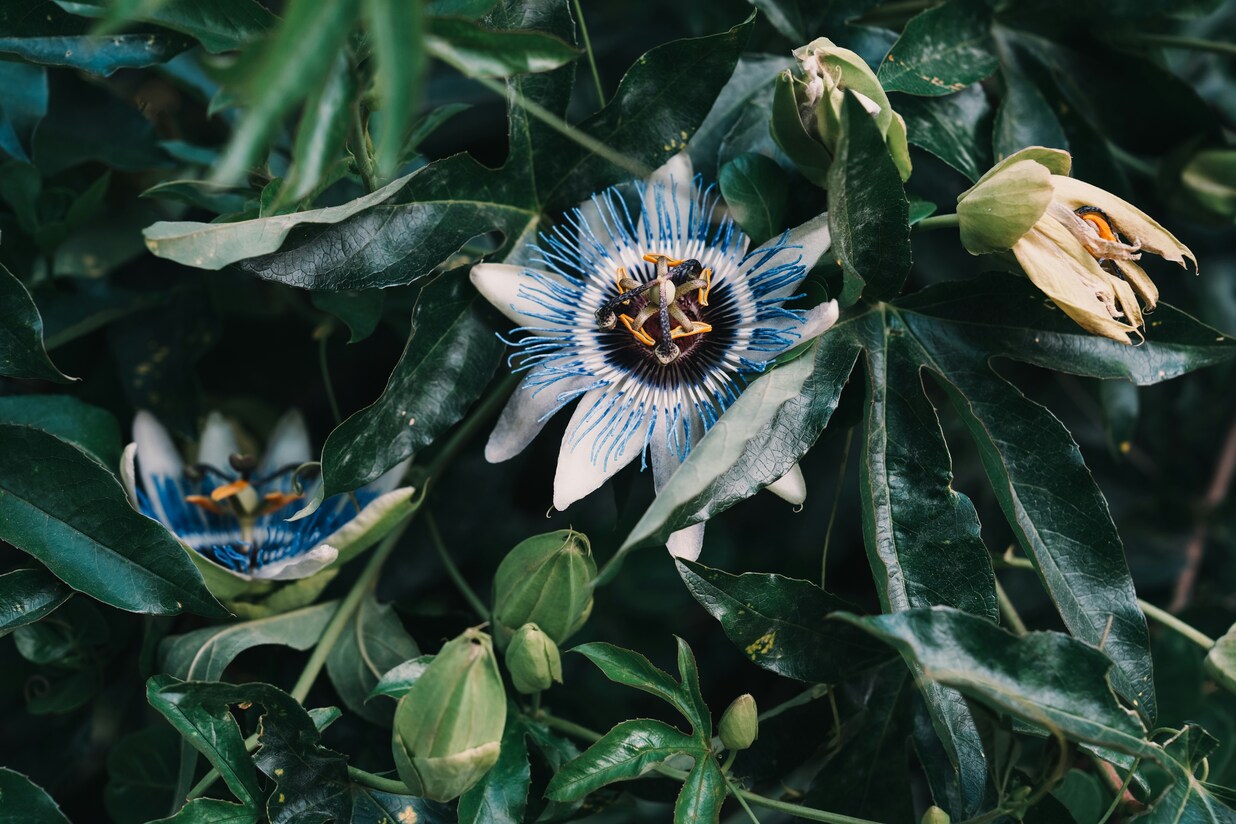
Passionflower is an exotic vine with striking, curly petals in shades of purple or blue, giving it a unique, tentacle-like appearance. It’s native to South America but also grows in the southern parts of the United States.
As part of the Passiflora family, not all passionflower has medicinal properties. However, one variety, Passiflora incarnata (P. incarnata), has been used for such purposes since the 16th century. ¹
How Does Passionflower Affect the Body?
Passionflower may increase gamma-aminobutyric acid (GABA) levels in the brain, a chemical responsible for mood regulation. As an inhibitory neurotransmitter, GABA blocks neurotransmitters that induce excitement, providing you with a calming effect. ²
Since passionflower contains GABA, some researchers believe it can help with:
- Anxiety disorders
- Insomnia (and other sleep disorders)
- Some forms of pain
Early research suggested GABA couldn’t cross the blood-brain barrier, limiting its effects. However, recent studies from 2024 challenge this view. Evidence now shows GABA can cross the barrier in small amounts and may also influence brain function through the gut-brain axis via the vagus nerve.

Can You Use Passionflower for Anxiety?
Yes, evidence suggests passionflower for anxiety works as an effective treatment. P. incarnata acts as an anxiolytic on the brain and body, reducing anxiety symptoms.
Recent human clinical trials support passionflower’s effectiveness. A 2024 study found it significantly reduced stress levels in participants with insomnia compared to a placebo. ³ Another recent trial showed passionflower helped patients taper off benzodiazepines while managing anxiety symptoms. ⁴
Earlier research from 2001 revealed it worked as well as oxazepam (a prescription anti-anxiety medication) for treating generalized anxiety disorder, but with fewer side effects like job performance impairment. ⁵
Animal studies provide additional support. A 2010 clinical trial found passionflower had similar effects to anti-anxiety medication in mice. ⁶ A 2016 study showed it reduced anxiety and improved memory in rats, likely due to its influence on GABA levels. ¹
The research shows promise, but scientists note the effects work best for people with moderate to severe anxiety symptoms. Those with mild anxiety may see less noticeable results.
What About Sleep?
If you struggle with anxiety, you may also experience sleep problems like insomnia. Passionflower may help you get better rest.
Recent human research shows positive results. A 2024 double-blind study found passionflower extract significantly increased total sleep time in adults with insomnia compared to a placebo. ³ A 2019 study using polysomnography confirmed it increased total sleep time by about 23 minutes. ⁷
Animal studies support these findings. Research from 2017 found P. incarnata had positive effects on sleep patterns in mice. ⁸ Another study shows passionflower increases slow-wave (deep) sleep, reduces rapid eye movement sleep, and helps rats fall asleep faster. ⁹
Other Benefits of Passionflower
Beyond anxiety and sleep, passionflower may offer these additional benefits:
- Reduces Menopause Symptoms – One study found passionflower provides a significant reduction in symptoms, such as depression, insomnia, headaches, and anger, after 3-6 weeks of use. ¹⁰
- Epilepsy – A 2007 study found that taking pasipay (a formula that includes P. incarnata) strengthened the time between seizures and their durations. ¹¹
- Inflammation – Passionflower may have some anti-inflammatory effects, but more research is needed to confirm its effectiveness. ¹⁰

Passionflower Side Effects and Safety
While the Food and Drug Administration (FDA) considers passionflower generally safe, it may cause the following side effects:
- Confusion
- Drowsiness
- Dizziness
In rare cases, large doses may lead to nausea, vomiting, or irregular heart rhythms. If you’re taking sedative medications like benzodiazepines (Ativan, Valium), passionflower may increase their effects. Talk to your doctor before combining them.
Pregnant women should avoid passionflower entirely. It may stimulate the uterus and potentially induce labor or cause behavioral issues in offspring. Parents should also consult their healthcare provider before giving passionflower to children, as there’s not enough evidence to confirm its safety for young people. If you’re breastfeeding, skip passionflower due to insufficient safety data.
Passionflower Dosage Recommendation
Since research on passionflower for anxiety is still developing, there’s no standardized dosage recommendation. Clinical trials have used varying amounts depending on the form and purpose. Most commercial products contain 250-900 mg per serving.
Here’s what clinical studies have used:
| Form | Dosage | Timing | Purpose |
| Capsules/Tablets | 300-500 mg | Once or twice daily | Anxiety, sleep improvement |
| Liquid Extract (drops) | 45 drops | Daily | Generalized anxiety disorder |
| Tea | 1 tsp dried leaves steeped 10-15 minutes | 1 cup, 3 times daily or before bed | Sleep quality, relaxation |
| Pre-Surgery | 500mg | 90 minutes before procedure | Acute anxiety reduction |
It’s also important to remember that natural products aren’t always regulated by the FDA. Quality and concentration can vary between brands. Many products also contain other active ingredients, so always read labels carefully and start with lower doses to assess your body’s response.
Final Word
While passionflower for anxiety can reduce symptoms effectively, it’s not a standalone cure. P. incarnata works best when combined with other anxiety treatments like therapy or lifestyle changes.
If you plan to add passionflower to your wellness routine, consult your doctor first. Passionflower can negatively interact with several medications, including:
- Sedatives and sleep medications (Ambien, Sonata, Lunesta) – may increase drowsiness.
- Benzodiazepines (Ativan, Valium, Xanax) – may amplify sedative effects.
- Blood pressure medications (enalapril, losartan, amlodipine) – may lower blood pressure too much.
- Blood thinners (warfarin, aspirin) – may increase bleeding risk.
- Tricyclic antidepressants (Elavil, Sinequan) – may enhance drowsiness.
If you’re scheduled for surgery, stop taking passionflower at least two weeks beforehand, as it may interact with anesthesia.
Frequently Asked Questions (FAQs)
How long does passionflower take to work for anxiety?
Passionflower’s effects on anxiety vary by form and individual. For acute anxiety (like before surgery), studies show it works within 30-90 minutes when taken as a capsule or liquid extract. For generalized anxiety disorder, research indicates you’ll need consistent use for 2-4 weeks to experience the full benefits.
Is passionflower as effective as prescription anxiety medication?
Clinical studies show passionflower works as well as oxazepam (a benzodiazepine) for treating generalized anxiety disorder. The key difference: passionflower causes fewer side effects, particularly less job performance impairment and daytime drowsiness.
Can I take passionflower every day for anxiety?
Yes, passionflower is considered safe for daily use at doses of 800 mg or less. Clinical trials have tested daily use for up to 4 weeks with positive results. However, there’s limited research on long-term use beyond a few months.
What’s the best form of passionflower for anxiety (tea, capsules, or liquid extract)?
Capsules and liquid extracts are more effective than tea because they contain concentrated, standardized amounts of active compounds. Clinical studies showing anxiety reduction used 300-500 mg capsules or 45 drops of liquid extract daily. Passionflower tea provides milder effects and works best for general relaxation or sleep support rather than treating moderate to severe anxiety symptoms.
Can passionflower make anxiety worse?
Passionflower doesn’t typically worsen anxiety, but some people experience side effects like confusion, dizziness, or drowsiness that may feel uncomfortable. If you have very mild anxiety symptoms, research suggests passionflower may be less effective for you. Additionally, combining passionflower with sedative medications can increase drowsiness excessively. Start with a low dose to see how your body responds before increasing.
References
¹ Jawna-Zboińska K, Blecharz-Klin K, Joniec-Maciejak I, Wawer A, Pyrzanowska J, Piechal A, Mirowska-Guzel D, Widy-Tyszkiewicz E. Passiflora incarnata L. Improves Spatial Memory, Reduces Stress, and Affects Neurotransmission in Rats. Phytother Res. 2016 May;30(5):781-9. doi: 10.1002/ptr.5578. Epub 2016 Jan 27. PMID: 26814055.
² Boonstra E, de Kleijn R, Colzato LS, Alkemade A, Forstmann BU, Nieuwenhuis S. Neurotransmitters as food supplements: the effects of GABA on brain and behavior. Front Psychol. 2015 Oct 6;6:1520. doi: 10.3389/fpsyg.2015.01520. PMID: 26500584; PMCID: PMC4594160.
³ Harit MK, Mundhe N, Tamoli S Sr, Pawar V, Bhapkar V, Kolhe G, Mahadik S, Kulkarni A, Agarwal A. Randomized, Double-Blind, Placebo-Controlled, Clinical Study of Passiflora incarnata in Participants With Stress and Sleep Problems. Cureus. 2024 Mar 20;16(3):e56530. doi: 10.7759/cureus.56530. PMID: 38646244; PMCID: PMC11026993.
⁴ Carminati M, Tondello M, Zanardi R. Passiflora incarnata L., herba, in benzodiazepine tapering: long-term safety and efficacy in a real-world setting. Front Psychiatry. 2024 Oct 4;15:1471083. doi: 10.3389/fpsyt.2024.1471083. PMID: 39429529; PMCID: PMC11486640.
⁵ Akhondzadeh S, Naghavi HR, Vazirian M, Shayeganpour A, Rashidi H, Khani M. Passionflower in the treatment of generalized anxiety: a pilot double-blind randomized controlled trial with oxazepam. J Clin Pharm Ther. 2001 Oct;26(5):363-7. doi: 10.1046/j.1365-2710.2001.00367.x. PMID: 11679026.
⁶ Elsas SM, Rossi DJ, Raber J, White G, Seeley CA, Gregory WL, Mohr C, Pfankuch T, Soumyanath A. Passiflora incarnata L. (Passionflower) extracts elicit GABA currents in hippocampal neurons in vitro, and show anxiogenic and anticonvulsant effects in vivo, varying with extraction method. Phytomedicine. 2010 Oct;17(12):940-9. doi: 10.1016/j.phymed.2010.03.002. Epub 2010 Apr 10. PMID: 20382514; PMCID: PMC2941540.
⁷ Lee J, Jung HY, Lee SI, Choi JH, Kim SG. Effects of Passiflora incarnata Linnaeus on polysomnographic sleep parameters in subjects with insomnia disorder: a double-blind randomized placebo-controlled study. Int Clin Psychopharmacol. 2020 Jan;35(1):29-35. doi: 10.1097/YIC.0000000000000291. PMID: 31714321.
⁸ Toda K, Hitoe S, Takeda S, Shimizu N, Shimoda H. Passionflower Extract Induces High-amplitude Rhythms without Phase Shifts in the Expression of Several Circadian Clock Genes in Vitro and in Vivo. Int J Biomed Sci. 2017 Jun;13(2):84-92. PMID: 28824345; PMCID: PMC5542920.
⁹ Guerrero FA, Medina GM. Effect of a medicinal plant (Passiflora incarnata L) on sleep. Sleep Sci. 2017 Jul-Sep;10(3):96-100. doi: 10.5935/1984-0063.20170018. PMID: 29410738; PMCID: PMC5699852.
¹⁰ Kim M, Lim HS, Lee HH, Kim TH. Role Identification of Passiflora Incarnata Linnaeus: A Mini Review. J Menopausal Med. 2017 Dec;23(3):156-159. doi: 10.6118/jmm.2017.23.3.156. Epub 2017 Dec 29. PMID: 29354614; PMCID: PMC5770524.
¹¹ Nassiri-Asl M, Shariati-Rad S, Zamansoltani F. Anticonvulsant effects of aerial parts of Passiflora incarnata extract in mice: involvement of benzodiazepine and opioid receptors. BMC Complement Altern Med. 2007 Aug 8;7:26. doi: 10.1186/1472-6882-7-26. PMID: 17686156; PMCID: PMC1973074.




Leave a Reply